AIT and IUID Marking for the Defense Industry and Its Suppliers
Bundeswehr AIT in accordance with TL A-0032 or U.S. DoD IUID in accordance with MIL-STD-130: REA supports suppliers in marking supplies, packaging, and technical components, as well as in conducting code quality verification and data structure inspection.

What marking requirements must defense industry suppliers meet?
Understand Marking Requirements | Discover ApplicationsWhether it’s a supply carton, a spare part, or a technical assembly: The type of marking required depends on the product, the material, the operating conditions, and the contractual specifications.
For packaging and logistics units, item, batch, and logistics data are often the primary focus. Machines, spare parts, and technical components, on the other hand, often require unique serial numbers and permanent markings with high readability.
REA supports suppliers in selecting suitable marking and verification technologies—from direct marking and labeling to optical code verification and data structure validation.
Four Areas of Application – Different Requirements

Marking cartons, packaging, and shipping units with product, batch, and logistics data—for reliable identification throughout the supply chain.
Typical applications:
carton marking, packaging labels, pallet marking, SSCC, transport containers.
Our solutions: REA JET, REA LABEL, REA VERIFIER.

Applying batch numbers, expiration dates, and machine-readable codes to food packaging—tailored to the packaging material, production speed, and labeling requirements.
Typical applications: best-by date printing, batch marking, outer carton labeling, and shipping labels.
Our solutions: REA JET, REA LABEL, REA VERIFIER.

Serial numbers, nameplates, and Data Matrix codes enable the unique identification of machines and replacement parts—even during long-term use, maintenance, and servicing.
Typical applications: serial numbers, nameplates, Data Matrix codes, permanent component marking, and spare part identification.
Our solutions: REA LASER, REA LABEL, REA VERIFIER.

Precise and permanent marking of metal parts and assemblies—tailored to the material, surface finish, and the required durability and readability.
Typical applications: component serialization, direct part marking, Data Matrix codes, and quality marking.
Our solutions: REA LASER, REA VERIFIER.
Two Sets of Requirements: Bundeswehr AIT/GS1 and U.S. DOD IUID
Suppliers to the defense industry have to comply with different identification requirements. Which requirements apply depends on the specific product, the application, and the contractual specifications.
What is the difference between AIT and IUID?
- Bundeswehr AIT/GS1 supports the standardized identification and data capture of supplies, packaging, and logistical units.
- US DOD IUID is used for the unique identification of specific individual items throughout their lifecycle.
Both sets of requirements use machine-readable codes. However, they differ in terms of their objectives, identification systems, and labeling requirements.

German Armed Forces: AIT, GS1, and TL A-0032
AIT stands for Automatic Identification Technology and enables the automated capture and assignment of supplies and logistical units.
GS1 standards provide standardized identification keys and data structures for this purpose. The Technical Delivery Specification TL A-0032 prints labeling requirements for its respective scope of application.
Typical identification data includes: GTIN/item identification , batch or lot, serial number, and SSCC for transport units—each only to the extent specified in the specific application. GS1-128 and GS1 DataMatrix may be relevant as data carriers. The GS1 Application Identifiers (AI) define the meaning of the contained data, e.g., (01) GTIN, (10) batch, (21) serial number, and (00) SSCC.
Typical requirements:
-
Standardized identification of supply goods and packaging.
-
Machine-readable marking using appropriate data carriers.
-
Correct structure of the required identification data.
-
Sufficient code quality for reliable capture.
U.S. / DoD: IUID, MIL-STD-130, and DFARS
IUID (Item Unique Identification) refers to the unique identification of individual items in the U.S. defense sector.
MIL-STD-130 prints requirements for the physical identification marking of military items. Additionally, contractual requirements and provisions of DFARS 252.211-7003 may apply.
For IUID applications, Data Matrix ECC 200 in particular is used as a machine-readable data carrier. The identification data has to be organized according to a defined structure. This includes, for example, Construct 1, which involves serialization within an organization, and Construct 2, which involves serialization within a part number. The CAGE code (Commercial and Government Entity Code), which uniquely identifies an organization, can be used as the organization identifier.
Typical requirements:
- Unique identification of individual items subject to labeling requirements.
- Defined IUID data structure.
- Appropriate and sufficiently durable marking.
- Verifiability of the optical code quality and the data it contains.
From Marking to Verified Identification—An Overview of REA Technologies
Reliable identification involves two key steps: First, the necessary information is applied to the product or its packaging. Next, the code is verified to ensure it meets the required optical quality standards and that its data structure complies with the supported specifications.
Step 1: Mark codes with ink, labels or laser
Depending on the material, surface, production process, and required durability, various coding and marking technologies are available.

Print variable text, barcodes, and 2D Codes directly onto compatible products and packaging—flexibly and with the ability to integrate into industrial processes.
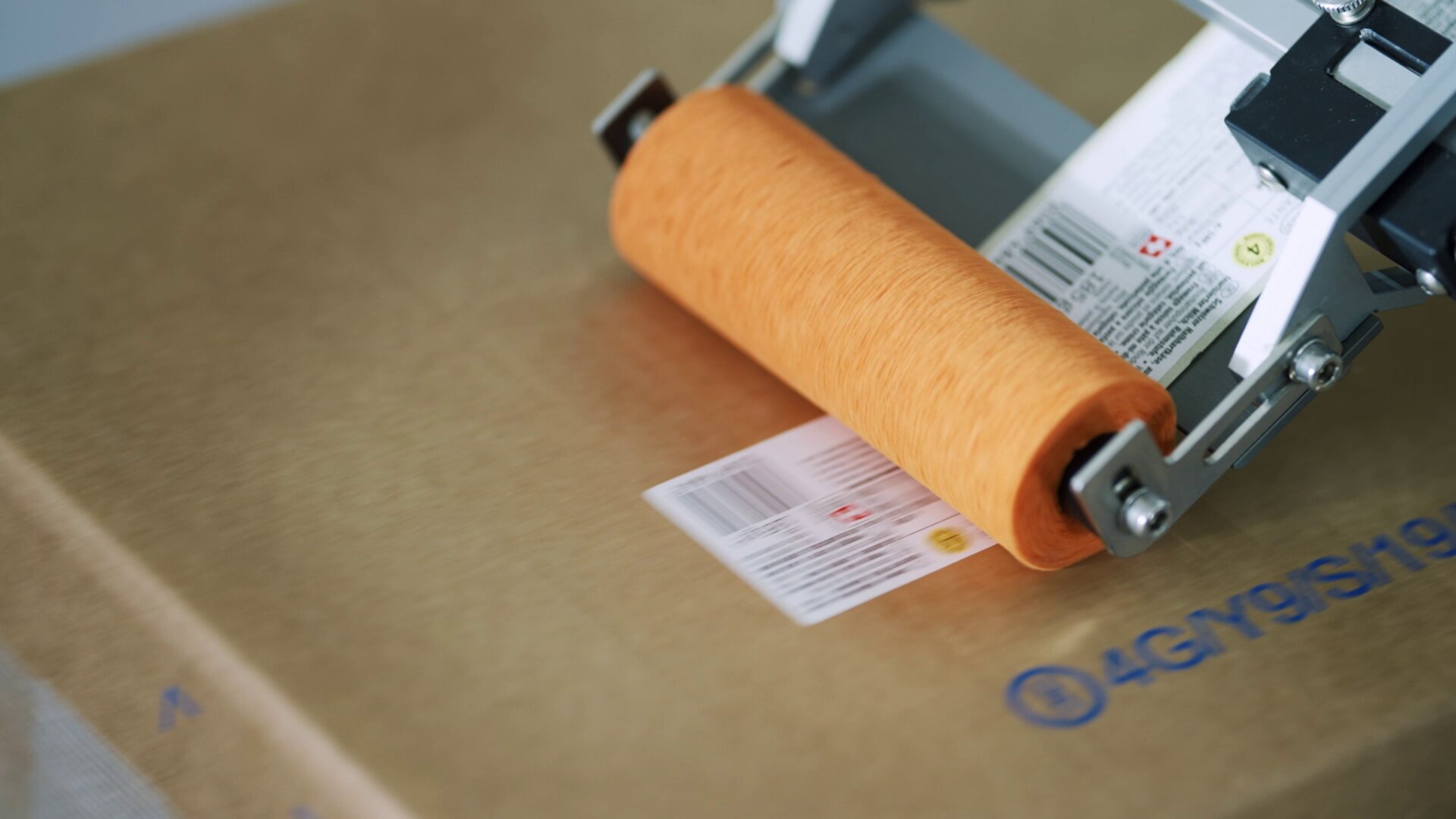
Print labels with variable information and apply them automatically to products, boxes, and shipping units.

Permanently and accurately mark serial numbers, plain text, and Data Matrix codes on suitable materials.
Step 2: Verify code quality and data structure
A machine-readable marking has to be present and reliably scannable and structured correctly in terms of content.
To meet these requirements, REA combines the REA VeriCube code verification system with the REA ScanLink software option.

Measure and document the quality of machine-readable codes using appropriate verification standards.

This software option supplements optical code verification with rule-based validation of supported data structures according to AIT and IUID.
Verify Code Quality and Data Structure—with REA VeriCube and REA ScanLink
Even a Data Matrix code of high optical quality may still contain incorrectly structured identification data.
- The REA VeriCube evaluates the visual code quality according to appropriate testing standards. Depending on the code type and marking method, standards such as ISO/IEC 15416, ISO/IEC 15415, or ISO/IEC 29158 may be relevant.
- REA ScanLink supplements the inspection by checking supported data structures. Specific inspection profiles are available for applications in the defense industry:
- “ait” test profile – German Armed Forces: Supportsrule-based inspection of stored GS1 data structures based on the requirements of TL A-0032.
- “iuid” inspection profile – U.S. Defense: Supportsthe inspection of stored IUID data structures in accordance with MIL-STD-130N, including Construct 1 and Construct 2.
Two validation tasks – one combined solution
The REA VeriCube evaluates the optical quality of the code. REA ScanLink additionally verifies the data structure based on the selected verification profile.
This enables suppliers to monitor marking quality, detect supported data structure errors, and document inspection results—for example, in production as well as during incoming and outgoing goods inspections.
This combination supports quality assurance but does not replace the inspection of all other contractual or regulatory requirements.

- Phone +49 6154 638 204
- Mobile +49 171 4407268
- E-mail wweigelt@rea.de
Marking in the defense industry requires more than just a machine-readable barcode or Data Matrix code. In addition to the optical code quality, the correct structure of the identification data is crucial. This applies in particular to the German Armed Forces’ marking requirements in accordance with AIT/GS1 and TL A-0032, as well as to the IUID specifications of the U.S. Department of Defense in accordance with MIL-STD-130.
With the REA VeriCube, REA offers a solution for standards-based code quality verification. The REA ScanLink software option supplements this with rule-based inspection of supported AIT and IUID data structures.
Wilfried Weigelt, Division Manager for REA VERIFIER, has many years of experience in the standardized quality inspection of barcodes and 2D Codes. His expertise includes, in particular, the evaluation of code quality and the requirements of international testing standards.
-
AIT refers to technologies and methods for the automatic identification of goods. IUID, on the other hand, describes the unique identification of individual items in the context of the U.S. DOD. The concepts differ, in particular, in terms of their objectives and the identification structures used.