ISO/IEC 15426: Standard for Barcode Verification Systems
ISO/IEC 15426 is a series of international standards that specifies requirements for the conformity of verification systems for barcodes and 2D Codes. ISO/IEC 15426-1 applies to verification systems for linear barcodes, while ISO/IEC 15426-2 applies to verification systems for two-dimensional codes. The goal is to ensure reliable and comparable verification results.
What is ISO/IEC 15426?
ISO/IEC 15426 defines test methods and minimum accuracy requirements for barcode verification systems. The series of standards also prints reference standards for their calibration.
It consists of two parts:
- ISO/IEC 15426-1:2006 applies to verification systems for linear barcodes (1D Barcodes).
- ISO/IEC 15426-2:2023 applies to verification systems for 2D codes (2D codes such as QR codes and Data Matrix codes).
The requirements are intended to ensure that the verification systems used for quality assessment deliver reliable, reproducible, and comparable results.
What is the difference between ISO/IEC 15426-1 and ISO/IEC 15426-2?
The main difference lies in the type of codes for which the verifiers are used for inspection.
- ISO/IEC 15426-1 for linear barcodes
ISO/IEC 15426-1 defines test methods and minimum accuracy requirements for verifiers of linear barcodes. The verification systems apply the quality assessment methodology for linear barcodes specified in ISO/IEC 15416.
Depending on the application, this includes, for example, linear codes such as Code 128, GS1-128, EAN/UPC, or Code 39.
- ISO/IEC 15426-2 for 2D Codes
ISO/IEC 15426-2 defines corresponding requirements for verifiers of multi-row barcodes and two-dimensional matrix codes. In particular, the quality assessment methodology specified in ISO/IEC 15415 is applied.
Relevant 2D symbologies include, for example, Data Matrix and QR code.
ISO/IEC 15426, ISO/IEC 15415, and ISO/IEC 15416—what's the difference?
These standards are closely related but serve different purposes.
| Standard | Scope of Application | ||
|---|---|---|---|
| Standard | ISO/IEC 15426-1 | Scope of Application | Conformity Requirements for Linear Barcode Verification Systems |
| Standard | ISO/IEC 15426-2 | Scope of Application | Conformity Requirements for 2D Code Verification Systems |
| Standard | ISO/IEC 15416 | Scope of Application | Quality Assessment of Printed Linear Barcodes |
| Standard | ISO/IEC 15415 | Scope of Application | Quality Assessment of Printed 2D Codes |
Simply put: ISO/IEC 15415 and ISO/IEC 15416 describe methods for evaluating the quality of codes. ISO/IEC 15426 defines requirements for verification systems that apply these evaluation methods.
This distinction is crucial for barcode testing that complies with standards. A code can only be reliably evaluated if the measurement and verification system used also ensures the necessary accuracy and comparability of the results.
Why is ISO/IEC 15426 important for barcode verification systems?
Barcode verification serves to objectively evaluate the quality of printed or directly marked codes. Simply reading a code successfully is not sufficient for this purpose.
A scanner essentially answers the question of whether a code can be read and decoded under the given conditions. A suitable verification system, on the other hand, evaluates defined quality parameters using standardized procedures.
To ensure that results from different measurements can be meaningfully compared, the verification systems used have to meet defined requirements.
A verifier’s compliance with ISO/IEC 15426 helps ensure that quality assessments can be conducted consistently, reproducibly, and comparably. This allows quality deviations to be detected early and reduces scanning or reading errors.
This is particularly relevant where barcode and 2D Code quality is an integral part of quality assurance, process control, or customer and industry requirements—for example, in retail, healthcare, and logistics. Standard-compliant verification helps companies reliably meet the applicable quality and labeling requirements in these sectors.
What requirements does ISO/IEC 15426 place on verification systems?
ISO/IEC 15426 defines test methods and minimum accuracy requirements for verifiers. This also includes reference standards for verifying or calibrating the verification systems.
For a standards-compliant quality assessment, the relevant measurement conditions have to be controlled and reproducible. Depending on the code, application, and underlying quality standard, factors such as illumination, measurement geometry, measuring aperture, and calibration are relevant.
- Illumination and measurement geometry: The optical measurement conditions have to comply with the applicable quality standard and test task, and have to be defined and reproducible. To achieve this, the devices use a uniform light source—typically a red LED with a wavelength of 660 nm—to avoid reflections and shadows. Illumination and measurement geometry influence the determined reflection and quality parameters and thus the reliable assessment of code quality.
- Illumination angle: The light has to strike the barcode at a 45° angle to simulate real-world scanning conditions.
- Measurement aperture: The aperture used for evaluation is selected according to the requirements of the applicable quality standard and the specific inspection task. The optical aperture is matched to the X-dimension of the barcode to precisely capture bar, space, and edge structures and reliably evaluate code quality.
- Calibration: A verifier’s measurement capability is verified using certified test charts (calibration charts) or defined reference standards that are traceable to national standards. This allows the verification system’s measurement results to be compared with known reference values, ensuring reliable, reproducible quality assessments.
The specific measurement conditions depend on the applicable standard, symbology, and inspection task.
Regular calibration using reference standards designed for this purpose helps to monitor the verification system’s measurement capability and ensure reproducible results.
What does ISO/IEC 15426 mean in practice?
In industrial applications, barcodes and 2D Codes that are difficult to read can have significant consequences. Codes that are not readable or can only be read unreliably can, for example, disrupt processes in production, logistics, and retail.
Verification makes it possible to objectively assess the quality of a code right where it can be influenced—for example, during or after the printing or marking process.
A standard-compliant verification system helps companies
- evaluate code quality based on defined criteria,
- detect quality fluctuations early on,
- document measurement results in a reproducible manner,
- monitor production and marking processes, and
- meet customer and industry requirements in a traceable manner.
Barcode verification thus goes beyond a simple readability check: It provides an objective quality assessment based on defined measurement methods.
Which ISO standard applies to which barcode or 2D Code?
Which standard is relevant for quality inspection depends, among other things, on the symbology used and the testing task.
- Linear barcodes:
ISO/IEC 15416 is of central importance for the quality assessment of linear barcodes. Requirements for corresponding verifiers are printed in ISO/IEC 15426-1. - 2D Codes:
ISO/IEC 15415 is of central importance for the quality assessment of 2D Codes. Requirements for corresponding verifiers are printed in ISO/IEC 15426-2.
In addition, depending on the application, marking process, industry, and symbology, other standards and specifications may be relevant.
REA VERIFIER develops verification systems for the objective quality assessment of barcodes and 2D Codes for various industrial applications.
Depending on the testing task, solutions are available for linear barcodes, matrix codes, and various marking methods. These solutions take into account the standards and specifications relevant to the respective application.
The selection of the appropriate verification system depends, among other factors, on the code type, size, substrate, marking method, and the quality requirements applicable to the specific application.

The REA VeriCube is a highly advanced and modernmatrix and barcode verification system that can be used flexibly and in a variety of ways across different industries.

The REA VeriMax is a verification system especially designed for seamless integration into production lines that verifiesboth 1D Barcodes and 2D-Matrixcodes.
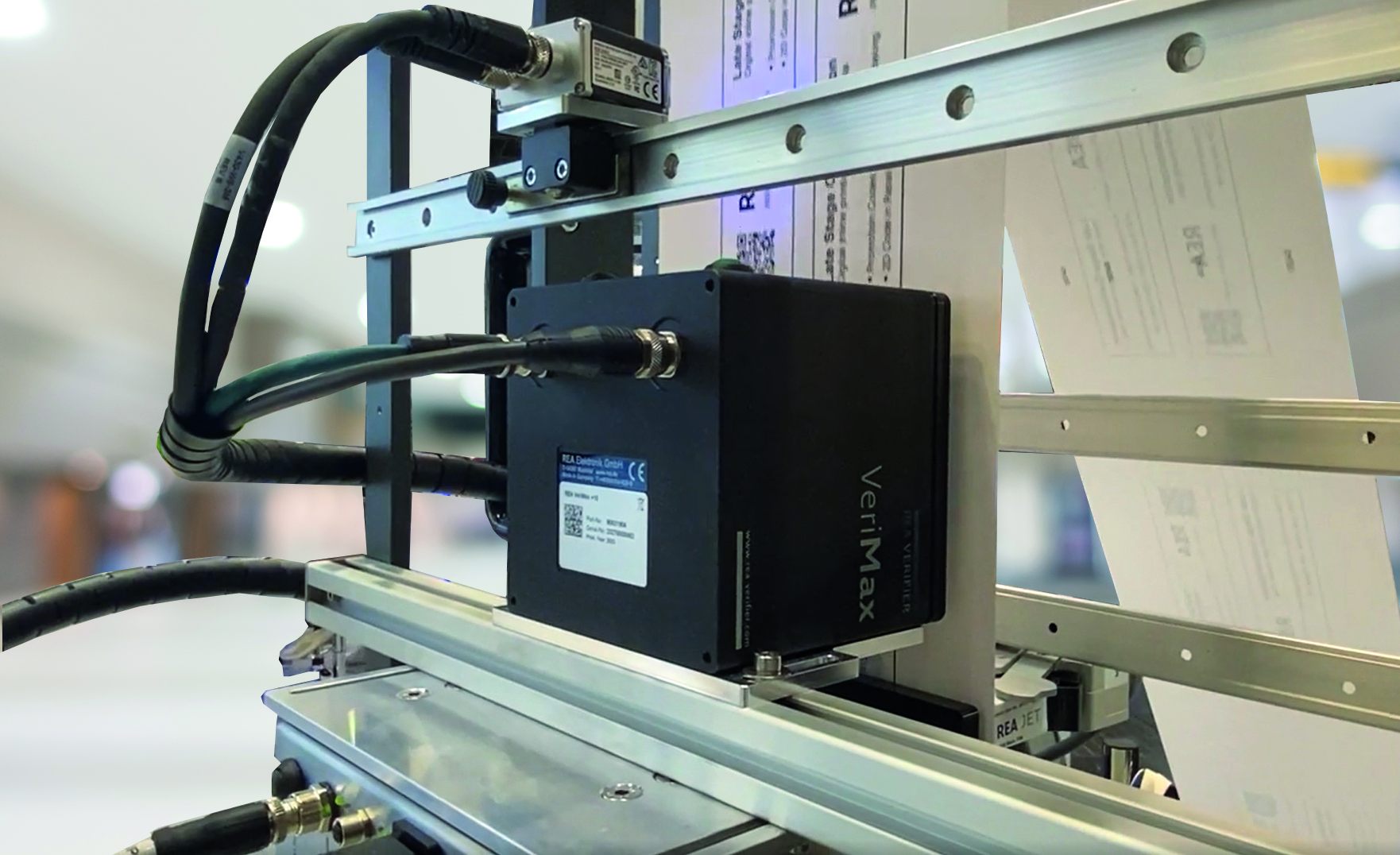

The REA VeriMax Mobile is a portable, offline code verification system for 1D and 2D codes. Thanks to its compact size and the ability to mount a tablet PC directly onto the device, it can be used anywhere.
-
ISO/IEC 15426-1 prints requirements for verification systems for linear barcodes. It is directly related to the quality assessment of linear barcodes in accordance with ISO/IEC 15416.
-
ISO/IEC 15426-2 prints requirements for verifiers of multi-row and two-dimensional codes. It is particularly relevant to quality assessment in accordance with ISO/IEC 15415.
-
ISO/IEC 15416 prints the methodology for evaluating the quality of linear barcodes. ISO/IEC 15426-1 defines requirements for verification systems that use this evaluation methodology.
-
No. A scanner is primarily used to read and decode a code. A barcode verification system, on the other hand, measures and evaluates defined quality parameters according to standardized procedures. Therefore, a successful read alone is not proof of code quality that meets standards.
-
Calibration is used to verify the measurement capability of a verification system based on defined reference standards. This helps ensure reliable and reproducible quality assessments.
-
ISO/IEC 15426-1 applies to verification systems for assessing the quality of linear barcodes. ISO/IEC 15426-2 applies to verification systems for assessing the quality of 2D Codes. Which other standards apply depends on the type of code and the testing task.