Reliable marking for hip mixed drink
20.000 cans per hour, maximum code quality and smooth product changeovers: In Krämer's new hall, REA Coding and Marking Systems ensure reliable processes right up to the pallet. Find out what's behind this successful concept!
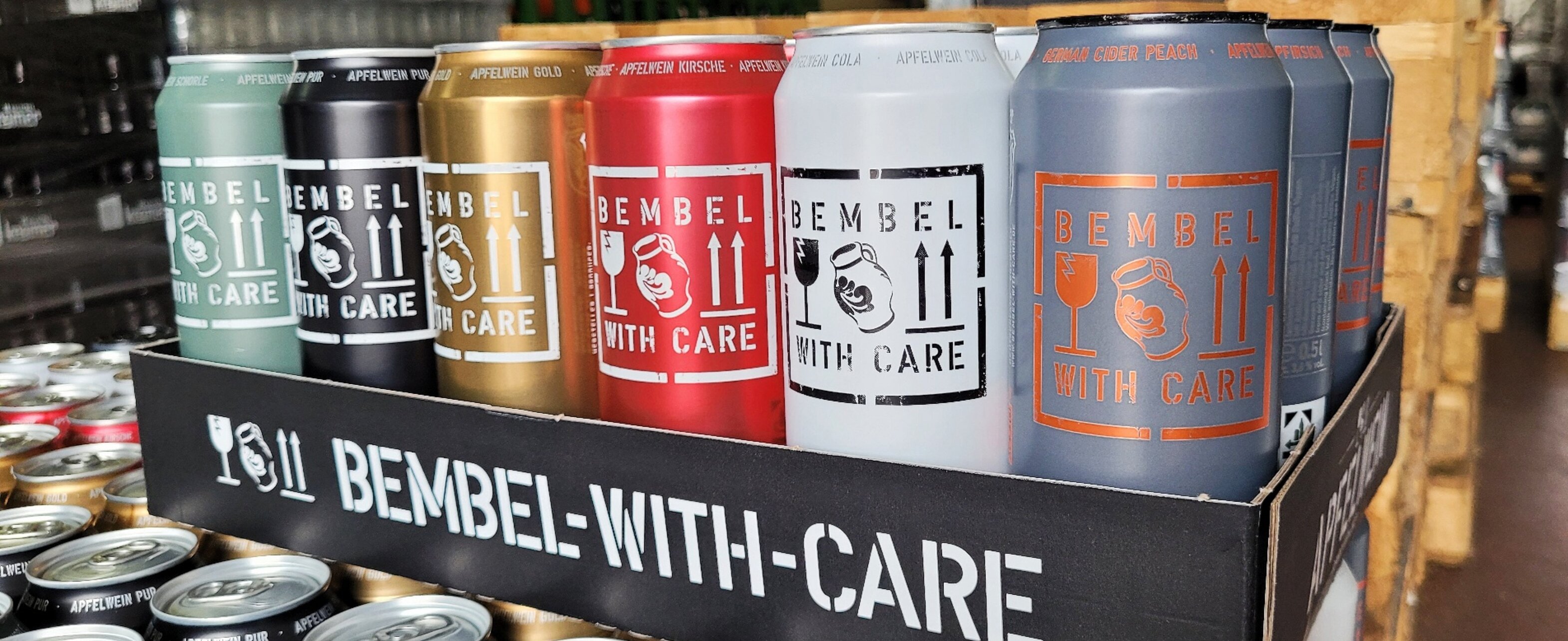
Germany's best-known cider comes from the Odenwald: BEMBEL-WITH-CARE. It also likes to call itself "canned fruit", as it is sold in beverage cans that come in different colors depending on the flavor. For marking the trays and pallets, the traditional company relies on a neighbor with a global reputation: REA Elektronik.
Cider is the drink of the Hessians. BEMBEL-WITH-CARE spices up its somewhat outdated image in the noughties and makes it popular among young adults: pure, sweet or sour syringes, with cherry or cola flavor and also packaged in colored cans. Trays with 24 cans each are popular party favors. The play on words in the catchy name paves the way for the drink to enter international markets.
From 2008, the inventors of BEMBEL-WITH-CARE cooperate with the Krämer winery in the Beerfurth district of the Odenwald town of Reichelsheim for production. in 2020, Krämer takes over the brand and develops it further. With success. in 2023, the traditional winery moves all processes from pressing to distribution to the site in the Odenwald, where the family business was founded in 1928. Krämer builds a new production hall and warehouse with a new can and returnable filling line. Today, 20,000 cans or 10,000 bottles can be filled there per hour.
"Good advice right from the start"
With sustainability in mind, Krämer looked for regional partners for the entire new building - including for the inline marking of the trays and shipping pallets. REA Elektronik, headquartered in Mühltal, just 25 kilometers away, was awarded the contract. Its products are in demand from industrial companies all over the world - REA continues to develop and manufacture exclusively in Germany. "It was important to us that REA is a company from the region," says Production Manager Jonathan Jekel. "REA also won the contract because its contacts gave us good advice right from the start, understood what was important to us and responded to our wishes."
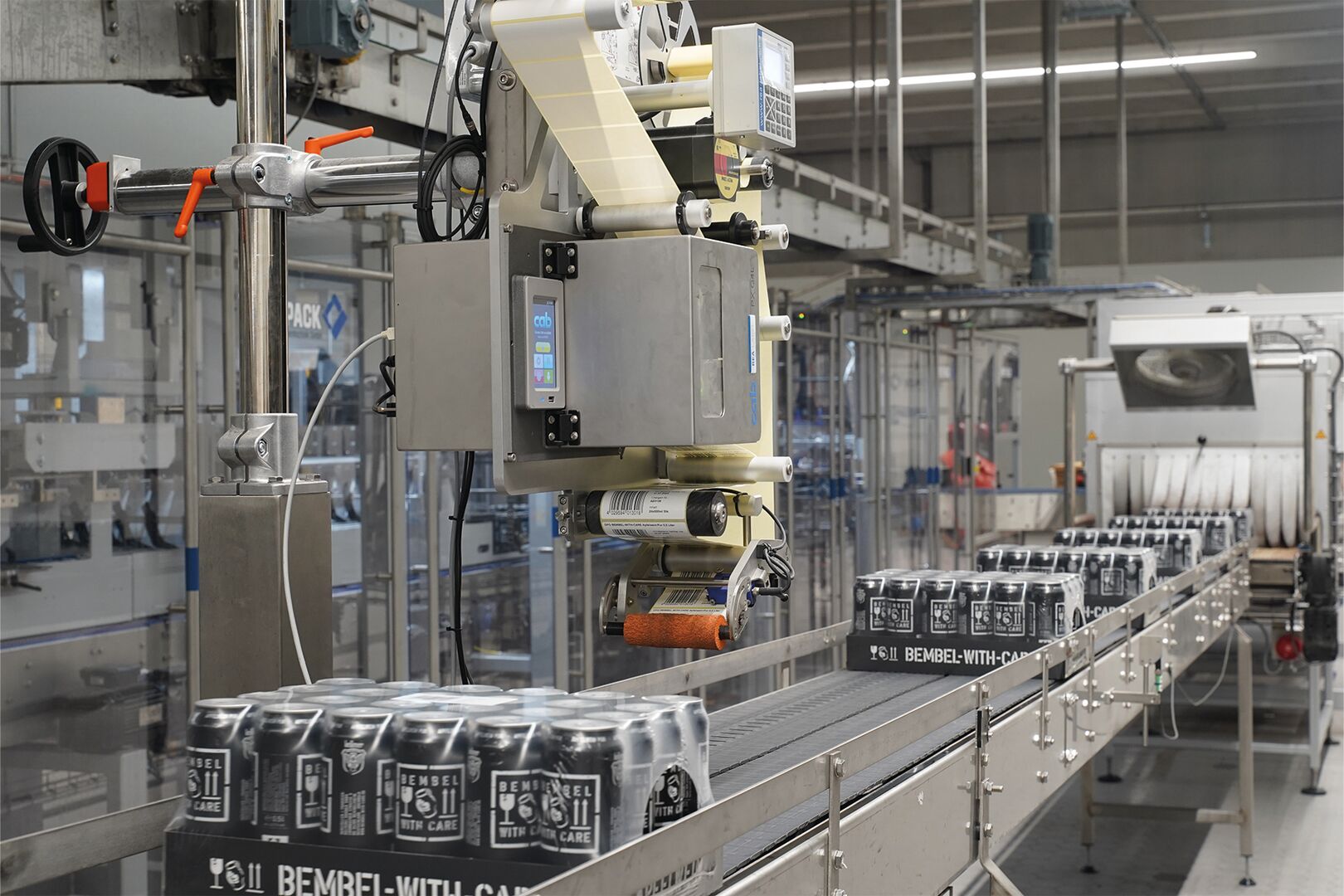
REA was already involved in the plant planning during the planning phase for the new hall. At an on-site meeting, the design of the coding and marking systems for the production lines was discussed together with REA. A REA LABEL labeling system with integrated CAB printing module prints and applies the tray labels with article number (EAN), product name and best before date in a continuous process. At the end of the production line, a REA LABEL pallet labeler marks two sides of the shipping pallet with a GS1 pallet label containing all the important information. For data control of the two labeling systems, REA supplied an industrial PC with Loftware NiceLabel labeling software and supported Krämer with the implementation.

Fast product changeover
"Because we have such a versatile product range and also fill for other suppliers, the entire machine has to be able to carry out fast product changeovers," says Jekel. Gerald Peter, Head of REA LABEL, adds: "The industrial PC with NiceLabel software, which Krämer uses to operate the two REA systems, obtains all the necessary information from the database. Our team of experts also carefully verifies that labels and ribbons are optimally matched. This guarantees the highest code quality and reliable printing results at all times. In this way, we ensure that the labels on the pallets and trays can be read without any problems in the incoming goods department or at the supermarket checkout."
The new building in Reichelsheim-Beerfurth was built in challenging times. "The global supply chain problems also affected the pallet labeler," recalls Jekel. "But REA developed an uncomplicated interim solution until all the parts were available and the system could be installed."

In the production line, the trays of 24 cans shrink-wrapped in foil first reach the REA LABEL continuous print dispensing system. The system prints the appropriate EAN label and applies it to the top as it passes through. Several trays are then stacked to form a pallet, which reaches the pallet labeler wrapped in foil via a conveyor belt. The pallet is stopped and the GS1 label is applied to the short and long sides.

Since the delivery of the two REA systems, their installation, the necessary fine-tuning of the interaction with the production line and the training of the employees, the systems have been running. At the moment, the only time they see or talk to each other is when the stock of consumables has to be replenished. That could change soon. "If we need new Inkjet Printers for marking individual containers, i.e. cans, that could be the reason for expanding our partnership," says Jekel.


- Phone +49 6154 638-0
- Mobile +49 151 15057381
- E-mail gpeter@rea.de
Gerald Peter has been the division manager of REA LABEL—the division for industrial labeling and coding and marking systems at REA Elektronik—for over a decade.
In this role, he drives the strategic development of customer-specific labeling technology and automation solutions, combining technological expertise with a deep understanding of the industry—from label dispensers to fully integrated custom solutions for modern production and logistics processes.
With his many years of experience in sales, system integration, and technical solutions, he is a recognized expert for efficient, reliable coding and marking solutions “Made in Germany.”


